


Hello, dear reader!
Picture this: you’ve finally done it — you’re about to fulfill your dream of touring Latin America. When you tell your family, who also love Spanish, your mother says: “If you pass through Mexico, bring me something typical.” Your father says: “Son, if you go to Argentina, bring me a pack of mate.” And finally, your sister says: “If you visit Peru, don’t forget to stop by Machu Picchu.”
There are a lot of “if” statements in those sentences, aren’t there?
Without even realizing it, your family gave you several examples of conditional sentences in Spanish, key structures for talking about possibilities, hypotheses, or consequences.
Do you want to learn more about this topic? Then come along, because today I’ll explain what conditionals are in Spanish and share examples and useful tips so you can use them correctly.
Let’s go!

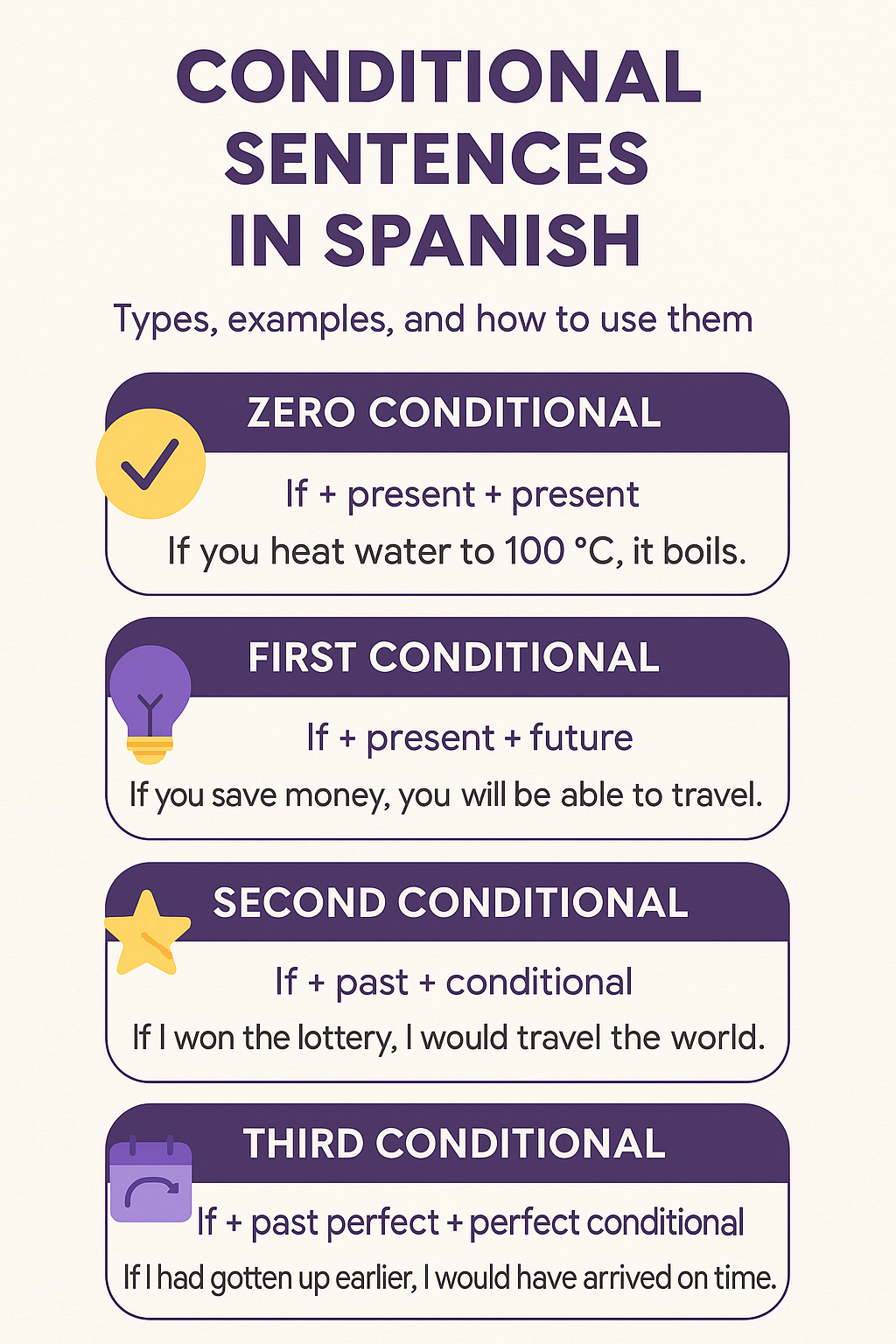
Zero Conditional: What Always Happens
We’ve all used this type of conditional sentence in our native language.
The zero conditional is used to talk about absolute truths or general facts — in other words, things that always have the same result.
Examples:
-
If you heat water to 100 degrees, it boils. Si calientas el agua a 100 grados, hierve.
-
If you sleep too little, you’ll feel tired. Si duermes poco, te sentirás cansado.
Easy, right?
Remember: use it to talk about things that always happen.
First Conditional: Future Plans and Real Decisions
Here we’re talking about situations that could really happen in the future, as long as a certain condition is met.
Here’s the basic structure and some examples:
-
Si + present indicative + simple future
Examples:
-
If you master conditional sentences in Spanish, you’ll communicate better. Si dominas las oraciones condicionales en español, te comunicarás mejor.
-
If you save money, you’ll be able to travel next year. Si ahorras dinero, podrás viajar el próximo año.
This type of conditional is one of the most commonly used in daily life.
Practice it and start using it today!
Second Conditional: Dreaming Costs Nothing
Have you ever imagined fun or pleasant hypothetical situations? The kind that might not happen, but just thinking about them makes you smile?
We use the second conditional to talk about these kinds of situations.
Structure:
-
Si + imperfect subjunctive + simple conditional
Examples:
-
If I could travel through time, I would meet Cleopatra and visit Egypt with her. Si pudiera viajar en el tiempo, conocería a Cleopatra y visitaría Egipto con ella.
-
If I won the lottery, I would travel around the world in 100 days. Si ganara la lotería, recorrería el mundo en 100 días.
So now you know: when you want to talk about dreams, wishes, or unlikely situations, this is the conditional you need.
Third Conditional: Reflecting on What Could Have Been
And now we come to the conditional that lets us reflect on the past. The third conditional is used to talk about situations that didn’t happen but would have had important consequences if they had.
Structure:
-
Si + past perfect subjunctive + compound conditional
Examples:
-
If I had gotten up earlier, I would have arrived on time. Si me hubiera levantado más temprano, habría llegado a tiempo.
-
If I had known you were coming, I would have prepared more dessert. Si yo hubiese sabido que vendrías, habría preparado más postre.
It might seem a bit more complex, but it’s perfect for expressing nostalgia, regret, or simply for reflecting.
Time to Practice: Ready for the Challenge?
Great job! Now you know the different types of conditional sentences in Spanish.
How about some practice? Here are a few exercises to reinforce what you’ve learned.
Tip: identify whether the situation is real, hypothetical, or in the past, and pay attention to the verb tense.
1. Complete with the correct form of the verb in parentheses
-
Si sigues practicando, _______ (hablar) español con fluidez.
If you keep practicing, you _______ (speak) Spanish fluently.Si mezclas rojo y azul, _______ (obtener) morado.
If you mix red and blue, you _______ (get) purple.Si viviera en México, _______ (comer) tacos todos los días.
If I lived in Mexico, I _______ (eat) tacos every day.Si haces más ejercicio, te _______ (sentir) mejor.
If you exercise more, you _______ (feel) better.Si tuviera más tiempo, _______ (viajar) por el mundo.
If I had more time, I _______ (travel) the world.
2. Choose the type of conditional used in each sentence: 0, 1, 2, or 3
-
Si llueve mañana, cancelaremos el picnic. → ( )
If it rains tomorrow, we will cancel the picnic. → ( )Si hubieras llegado a tiempo, habrías visto el inicio de la película. → ( )
If you had arrived on time, you would have seen the beginning of the movie. → ( )Si fuera invisible, entraría a todos los conciertos gratis. → ( )
If I were invisible, I would get into all the concerts for free. → ( )Si calientas hielo, se derrite. → ( )
If you heat ice, it melts. → ( )
Answers – Exercise 1
-
hablarás → Primer condicional (real y posible) / First conditional (real and possible)
-
obtienes → Condicional cero (hecho general) / Zero conditional (general fact)
-
comería → Segundo condicional (hipotético) / Second conditional (hypothetical)
-
sentirás → Primer condicional (real y posible) / First conditional (real and possible)
-
viajaría → Segundo condicional (hipotético) / Second conditional (hypothetical)
Answers – Exercise 2
- 1 → Primer condicional / First conditional
- 3 → Tercer condicional / Third conditional
- 2 → Segundo condicional / Second conditional
- 0 → Condicional cero / Zero conditional
A World of Possibilities with “If”
Well done! Now you know how to create and recognize conditional sentences in Spanish. You can talk about what you dream of, absolute truths, what could have been, and what can still happen.
Keep practicing, dear Spanish learner, and remember that each “if” is a door to new ways of expressing yourself.
I’ll see you on the next language adventure!