


If you've ever found yourself frozen mid-conversation, wondering whether to say "también" or "tampoco," you're not alone. These two little Spanish conversation words cause more confusion than almost any other beginner Spanish confusion words out there. But here's the good news: after reading this post, you'll finally understand the difference between también and tampoco, not just memorize some random rules.
The Basics: Me Too vs Me Neither Spanish
You probably already know that "yo también" means "me too" and "yo tampoco" means "me neither." Simple enough, right? Well... kind of. The full picture is actually a bit more nuanced than that, and understanding those nuances is what will take your Spanish from "I think I got it" to "I totally got it."
The secret to mastering these beginner Spanish confusion words? Practice, practice, and more practice. So let's dive deep into both options and make sure you can confidently agree or disagree in Spanish without completely changing what you mean to say.
También: Your Positive Agreement Superstar
Let's start with the sunnier of the two: también. I mean that literally, by the way, this is your go-to word for positive sentences. When you want to agree with someone and say "yes! me too!" or "yes! I agree!" you'll reach for también.
How to Use También in Spanish with "Gustar"
Here's a classic example. Imagine someone says:
- Me gusta el café. (I like coffee.)
You can respond with:
- A mí también. (Me too.)
Now, pay close attention to that structure because this is where a lot of learners trip up. It would sound super weird and robotic if you just replied with "También" all by itself. When you're talking about likes and dislikes, you need that little intro: "A mí."
That's the preposition "A" plus the personal pronoun, in this case "mí" because you're talking about yourself. Think of it as the complete package for agreeing about preferences.
How to Use También in Spanish with Other Verbs
But también isn't just for talking about what you like. Let's see it in action with a different type of sentence:
- Ellos van a una fiesta el viernes. (They're going to a party on Friday.)
If you're going too (and honestly, who doesn't love a good party?), you can say:
- Nosotros también. Or even better: Nosotros también vamos.
Here's something super important to notice: look at where "también" sits in that sentence. We place it between the subject and the verb: Nosotros también vamos.
See the pattern in both examples? They're both completely positive sentences. Someone likes coffee, and you like it too. They're going to a party, and you're going too. You're agreeing with positive statements. That's your key to remembering when to use también.
Tampoco: The Negative Agreement Champion
Now let's move on to the other side of the coin: tampoco. This is your word for negative agreement; it works the same way as también, but for negative sentences. Understanding this difference between también and tampoco is crucial for natural Spanish conversation.
Expressing "Me Neither" with Tampoco
Let's look at a similar example to what we saw before:
- No me gusta el té. (I don't like tea.)
If you agree (you don't like it either), you'd say:
- A mí tampoco. (Me neither.)
Once again, remember that when we're talking about likes and dislikes, you need that little addition at the start: "A mí." And please, don't just say "Tampoco" by itself. That would sound kind of rude or abrupt. Not exactly the vibe you want in a friendly conversation!
Using Tampoco with Regular Verbs
For other types of sentences, we follow the same structure we used with también. Check this out:
- Yo no voy a trabajar mañana. (I'm not going to work tomorrow.)
Your response could be:
- Él tampoco. Or: Él tampoco va a trabajar. (He's not going to work either.)
Remember the placement rule: tampoco goes between the subject and the verb, just like también does. The only difference? You're using it with negative statements instead of positive ones.
Your Easy Formula for También vs Tampoco
Let's make this crystal clear with a simple formula you can remember:
- Positive statement + you agree = Yo también
- Negative statement + you agree = Yo tampoco
That's it! When you're trying to agree or disagree in Spanish, ask yourself: Is the first statement positive or negative? Then match your response accordingly.
But Wait... What If You Don't Agree?
Here's where things get interesting. What happens when you don't agree with what someone said? This is where many Spanish learners get confused and think they should automatically use one of these Spanish conversation words.
Let's say someone tells you:
- Yo trabajo los domingos. (I work on Sundays.)
But you don't work on Sundays. You can't say "también" because that would mean you do work on Sundays. And just because you're saying "no," it doesn't mean you automatically use "tampoco" either.
Why not? Because the original statement is positive. This person does work on Sundays, so tampoco doesn't fit the situation.
The solution is actually super simple: you don't need to use también or tampoco at all! A straightforward "Yo no" is enough.
The Opposite Scenario
The same logic applies when someone makes a negative statement that you disagree with:
- Yo no juego fútbol. (I don't play soccer.)
But let's say you do play soccer. Again, "también" and "tampoco" don't work here. You can drop them completely and just say: "Bueno, yo sí!" (Well, I do!)
See? When you're actually disagreeing with someone (rather than agreeing), these words don't come into play at all. You just state your opposite position directly.
The beauty of understanding the difference between también and tampoco is that once you get it, it becomes second nature. These beginner Spanish confusion words stop being confusing and start being tools that make your conversations flow naturally.
Think of también as your positive echo -you're bouncing back in agreement with something affirmative. Tampoco is your negative echo- you're matching agreement with something negative. The key is that both are about agreement. You're saying "same here!" whether that "same" is positive or negative.
Practice Makes Perfect
The best way to lock this in? Start using these words in your daily Spanish practice. Next time you're having a conversation, pay attention to opportunities to use también or tampoco. Notice when someone makes a statement you agree with, identify whether it's positive or negative, and choose accordingly.
And here's a little challenge for you: if I say "Yo entendí todo en esta lección" (I understood everything in this lesson), I want you to tell yourself, "Yo también!" Because honestly, if you've made it this far, you definitely have this down.
Your También vs Tampoco Cheat Sheet
Before we wrap up, here's a quick reference you can bookmark:
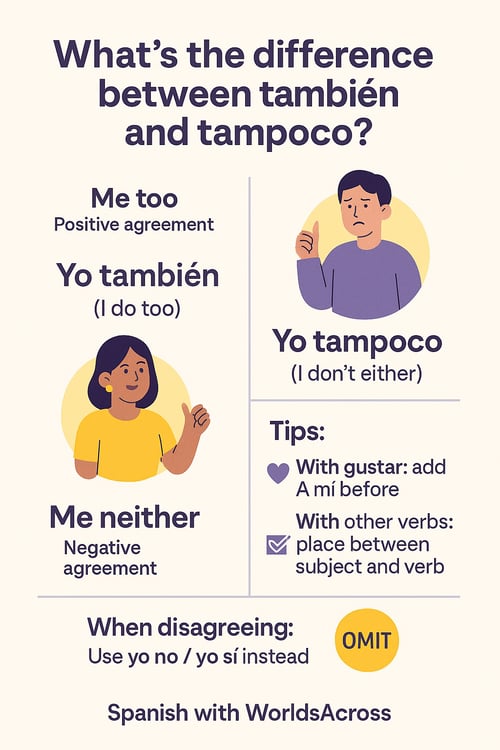
- También = me too (positive agreement)
- Tampoco = me neither (negative agreement)
- With gustar: add "A mí" before también/tampoco
- With other verbs: place también/tampoco between subject and verb
- When disagreeing: skip these words and just state your position (yo no / yo sí)
Mastering how to use también in Spanish and how to use tampoco in Spanish isn't about memorizing complicated grammar rules. It's about understanding the simple logic behind these Spanish conversation words: match positive with positive, negative with negative, and you're golden.
The también vs tampoco distinction is one of those things that seems tricky at first but becomes completely natural with a bit of practice. So don't stress if you mix them up a few times as you're learning, that's totally normal! Just keep practicing, stay aware of whether you're agreeing with something positive or negative, and soon you'll be using these words like a native speaker.
Now you're ready to confidently agree or disagree in Spanish without second-guessing yourself. Go forth and practice! Your Spanish conversations are about to get a whole lot smoother.