

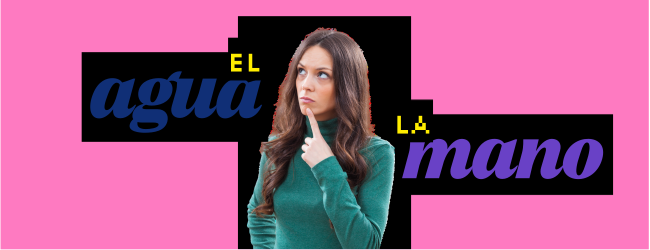
If O means masculine and A means feminine, then why is it la mano?
Today, I'll show you why understanding the gender of Spanish nouns is easier than you might think.
Let's see the general rules to understand gender in Spanish, how this affects the entire sentence, and some really important exceptions that you should know to avoid some very common mistakes.
The Basic Rules: Masculine vs Feminine Nouns in Spanish
We'll jump right in with these two rules:
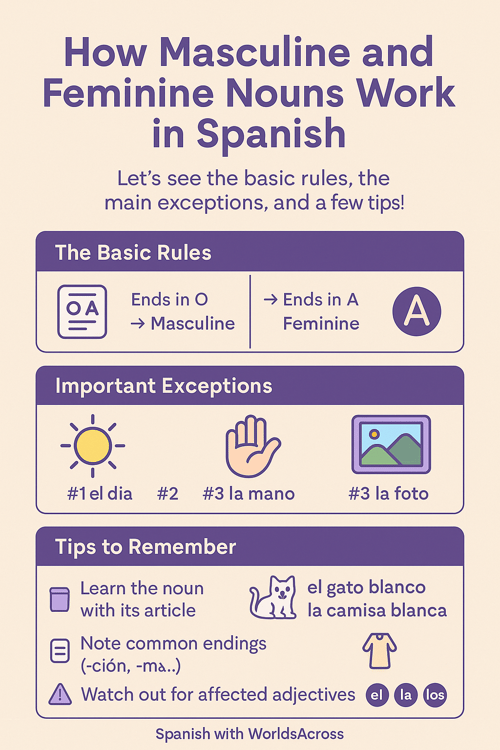
- Masculine nouns usually end in the letter O.
- Feminine nouns usually end in the letter A.
Sounds pretty simple.
This is one of the very first things we teach students at the beginner level.
And wait, what exactly are nouns? Easy. Just all the words we use to name people, places, and things.
And they're usually accompanied by articles, these little words that will confirm for us the gender and number of the nouns: El, La, Los, Las.
These Spanish articles el, la, los, las depend on whether the nouns are masculine, feminine, singular, or plural.
Once you get that, you have all you need to get started.
Masculine Noun Examples
For example:
- El teléfono, the phone.
- El dinero, the money.
- El baño, the bathroom.
These are all masculine nouns in Spanish, even if they seem completely neutral in English. As you can see, they all end in the letter O.
Feminine Noun Examples
Now, for the feminine nouns, remember, they usually end in the letter A.
For example:
- La comida, the food.
- La familia, the family.
- La lluvia, the rain.
Again, these are all things we talk about every day, right? Who could go on without talking about food in Spanish! jaja
But these are just the basics, alright?
Now it's time to look at the exceptions that no one warned you about... Until now.
Spanish Noun Endings: Beyond O and A
Understanding Spanish noun endings is your secret weapon for mastering the gender of Spanish nouns. Let's look at some patterns that work almost every time!
Feminine Endings: "-ción" and "-sión"
For example, words that end in "-ción" or "-sión"
And trust me, they're super common, like:
- La canción, the song.
- La televisión, the television.
You couldn't learn Spanish without the songs and the TV shows, right? Where would we be without Shakira and La Casa de Papel?
Feminine Endings: "-dad" and "-tad"
And the next one, also for feminine nouns, is words that end in "-dad" or "-tad"
Do you know any of them? Think for a second...
Yes, there are some nice and useful ones like:
- La ciudad, the city.
- La universidad, the university.
- La amistad, the friendship.
All of these words are feminine too.
Masculine Ending: "-ma"
But let's take a second to see other masculine nouns.
For example, words that end in "-ma"
Yes, they end in A, but, because of the M before, because they come from Greek, they're actually masculine nouns.
Why is this important to remember? Because you'll find some necessary words for your everyday conversations, like:
- El problema, the problem.
- El clima, the weather.
- El idioma, the language.
I mean, imagine making the mistake of saying "la idioma español". No, let's not do that.
The Tricky Case: Words Ending in "E"
Now, before moving on to articles, adjectives, and common mistakes, we have a tricky type of words.
These all end in the letter E, and there's not just one easy rule to decide if they're masculine or feminine. You'll have to learn them as they come.
For example:
How come it's el café, the coffee...
But also la clase, the class.
There's also el viaje, the trip...
But la noche, the night.
See? All four of them end in E, but some are masculine, and some are feminine.
Let me give you a trick to learn and actually remember the gender of all these nouns and every single one you learn from now on...
Don't just learn the noun by itself like "libro" means book, and then learn that libro is a masculine noun. No.
It's much easier if you learn the noun with the article at once. El libro. El reloj. La ropa. La playa.
That's much more effective!
Every time you hear a new noun, pay attention to the article before it. That's all you need to keep track of them without memorizing endless rules, okay?
El vs La in Spanish: Understanding the Articles
The Spanish articles el, la, los, and las are non-negotiable parts of the language. You can't skip them as we do in English!
Here's the breakdown:
- El = masculine singular (el gato, el libro)
- La = feminine singular (la casa, la noche)
- Los = masculine plural (los gatos, los libros)
- Las = feminine plural (las casas, las noches)
In English, we say "cats are cute" with no article. But in Spanish? You must say "Los gatos son lindos." Always use the article!
Spanish Adjectives Agreement: The Domino Effect
Now you're ready to go a little deeper on this subject, right?
You're about to see that the gender of the nouns affects more than the article that goes before it.
Let's take a quick look at how this affects the adjectives we use, too.
For example:
- El libro nuevo.
- La película nueva.
It's the same adjective, but the ending changes according to the gender of the noun, you see?
That's essential! If you said "el libro nueva," it would sound terrible, it would be incorrect.
And this happens with most adjectives, even colors. Take a look:
- Los zapatos blancos.
- La camisa blanca.
See? Again, we have the same adjective, but it changes in gender and number with the noun.
It kind of copies the ending. That's the trick to remember it, okay?
This is what we call Spanish adjectives agreement, and it's super important for speaking naturally!
Masculine and Feminine Rules Spanish: Gender by Context
And this, my friend, brings us to a very interesting point.
Sometimes, the gender of the noun is determined by the biological gender of the person we're talking about.
For example, professions:
- To say teacher, it depends on the gender of the person: El profesor or La profesora.
- Same thing with another profession like doctor: El doctor or la doctora.
However, as you keep learning them, you'll see that some of them are actually the same for both genders.
For example: el / la estudiante – el / la artista.
And now here's a fun bit: this happens with some animals, too!
That's why you can say: el gato o la gata.
Spanish Noun Gender Exceptions: The Rule Breakers
And finally, just like I said, I will share with you some trickster nouns that will save you from common mistakes.
These are a few examples of Spanish noun gender exceptions that break the rules we learned at the beginning.
El día
First of all, el día.
The day. It ends with A, yes, but it's still a masculine noun, so be careful with it.
La mano
Next, we have la mano.
Something as easy as the hand. It ends with O, usually a sign of masculine nouns.
But you have to remember this one is an exception to the rule too. It's feminine!
La foto
Just like the next one: la foto.
The picture is feminine. It's never el foto.
If you can keep track of these exceptions, you're already making a lot of progress.
Your Action Plan for Mastering Spanish Noun Gender
So, just keep in mind:
The basic rule is: if it ends in O, it's masculine. If it ends in A, it's feminine.
Keep an eye out for other common Spanish noun endings like -ción, -sión, -dad, -tad, and -ma.
Be aware of the exceptions like la mano, el día, and la foto.
Always try to learn the nouns with their articles to remember them more easily.
Remember that masculine and feminine rules Spanish learners need to master, also affect adjectives!
And understand the difference between el vs la in Spanish by paying attention to noun endings.
This is all you need for a solid foundation on this topic! Good job!
If you enjoyed this post, or if you have any questions at all about masculine vs feminine nouns in Spanish, go ahead and let me know in the comments.
I'll be right here ready to help.
And, most importantly, don't forget to like this post and subscribe to our updates so you never miss our articles with practical advice and everyday examples to help you learn real Spanish.